
How to Grow on Substack: The Dual-Engine SEO & Platform Strategy
How to grow using Notes, Recommendations, Google SEO, Substack SEO and Google Search Console

Starting a Substack is easy, but having a Substack SEO Growth Strategy and scaling it past your immediate group of friends and family is where most writers hit a wall.
The internet is flooded with generic advice: “Write great content,” or “Post consistently.” But relying on the quality of your writing alone ignores a massive reality. To build a thriving publication, you must treat growth as a system.
The most successful publications don’t rely on a single channel. Instead, they use a dual-threat growth strategy: mastering Substack’s internal ecosystem while simultaneously opening the floodgates to external traffic via Google.
This playbook breaks down the exact four-pillar framework you need to scale your Substack from zero to thousands of subscribers by combining platform mechanics with search engine optimization.
Pillar 1: The Substack Growth Strategy & Foundation of Trust (The Art of Recommendations)
Substack’s built-in recommendation feature is arguably the most powerful organic growth engine ever created for newsletters. When another writer recommends you, their new subscribers are presented with your publication the moment they sign up. It is a pure transfer of authority.
However, the common mistake is treating this feature like a transactional growth hack. Blatantly messaging strangers with “I’ll recommend you if you recommend me” leads to low-quality matches and ignored emails.
The Relationship-First Framework
To build a network of genuine recommendations, you must focus on mutual audience alignment:
Identify Peer Publications: Look for Substack writers within your niche who have a similar or slightly larger audience size.
Build Authentic Rapport: Before making any requests, engage deeply with their work. Leave insightful comments on their posts and share their essays on your own social channels.
The “Value-First” Ask: When you finally reach out, make the pitch about their readers, not your growth. Frame it around how your unique content fills a gap or adds a fresh perspective to the topics they already cover.
For a step-by-step blueprint on how to pitch other writers without sounding spammy, read this deep dive on how to ask for a Substack recommendation.
Pillar 2: High-Velocity Networking on Substack Notes
If recommendations are your long-term passive growth engine, Substack Notes is your short-term active catalyst. Notes functions as Substack’s internal micro-blogging feed, but unlike traditional social media platforms, its primary objective is to convert casual scrollers into direct newsletter subscribers.
For beginners, Notes is the ultimate equalizer. You don’t need thousands of subscribers to get noticed; you just need to understand how to stir conversations.
![[Casual Reader on Notes] ➔ [Reads Insightful Comment] ➔ [Hovers Over Profile] ➔ [One-Click Subscribe]](https://substackcdn.com/image/fetch/$s_!9Y58!,f_auto,q_auto:good,fl_progressive:steep/https%3A%2F%2Fsubstack-post-media.s3.amazonaws.com%2Fpublic%2Fimages%2Fdd5b601d-c344-41ee-b0ee-0d389d9bd149_737x309.jpeg "[Casual Reader on Notes] ➔ [Reads Insightful Comment] ➔ [Hovers Over Profile] ➔ [One-Click Subscribe]")
The Beginner Notes Playbook
Avoid the “Link Dumping” Trap: Do not just drop links to your latest articles. Treat Notes as a standalone publishing platform. Write short-form, punchy insights, hot takes, or actionable tips that provide immediate value in the feed.
Engage via “Stealth Commencing”: Find top-tier publications in your niche. When they post a Note, be among the first to leave a highly thoughtful, comprehensive response. This hitches your profile to their massive visibility, driving traffic back to your page.
Use Visual Hooks: Quotes, cleanly formatted bullet points, and charts perform exceptionally well on Notes and help your content stand out in a crowded feed.
If you are completely new to the feed and want to maximize your reach from day one, check out this comprehensive Substack Notes strategy for beginners.
Pillar 3: Opening the Google Traffic Spigot
While Substack’s internal tools (Notes and Recommendations) are incredible for connecting with existing Substack users, you are limiting your growth if you only stay within the platform’s walls. To achieve explosive, long-term scale, you must tap into the billions of searches happening on Google every single day.
Many writers view Substack purely as an email platform. In reality, Substack is a powerful Content Management System (CMS) optimized to rank on search engines.
Why Marry Substack SEO with Google SEO?
When you combine internal platform mechanics with standard SEO, you build an unstoppable, compounding traffic loop.
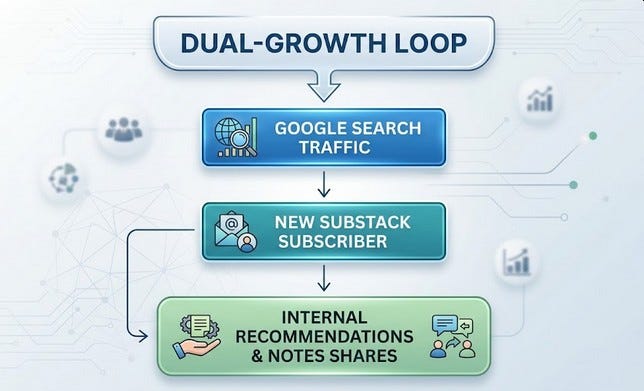
When you target specific keywords that your ideal readers are actively searching for, Google brings evergreen traffic to your essays month after month—long after your initial email blast has left your subscribers’ inboxes.
Quick Wins for Substack SEO
Keyword-Optimized Headlines: Ensure your post title matches what people actually type into Google, rather than relying solely on poetic or vague phrasing.
Clean Formatting: Use headers (H1, H2, H3) logically to help Google’s bots understand the structure of your article.
Optimized Post Descriptions: Craft an enticing meta description in your Substack post settings to maximize your click-through rate (CTR) on search engine result pages.
To fully unlock this strategy and understand how to outrank traditional blogs, explore why you should use Google SEO with Substack SEO for growth.
Pillar 4: Data-Driven Scaling with Google Search Console
You cannot optimize what you do not measure. Once you begin writing with an SEO-focused mindset, you need a way to track which keywords are driving impressions, which articles are ranking on page one, and where your organic traffic is originating.
Substack’s native dashboard gives you great data on open rates and subscriber sources, but it tells you absolutely nothing about user behavior on search engines.
That is where Google Search Console comes in.
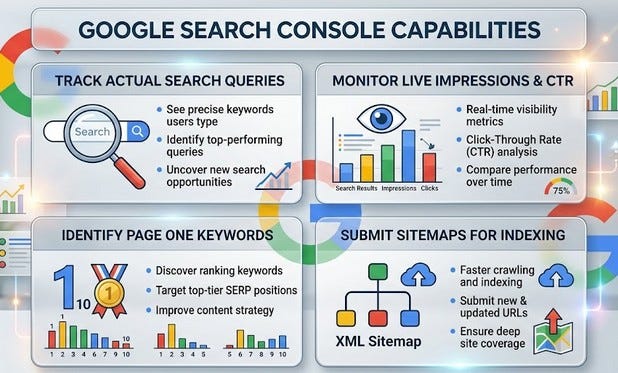
By connecting Google Search Console to your Substack backend, you gain access to a goldmine of data that allows you to reverse-engineer your growth:
Find “Hidden” Keywords: Discover keywords you are accidentally ranking for on pages 2 or 3 of Google, and update your articles to push them to page 1.
Fix Indexing Issues: Ensure Google is successfully crawling and indexing every new essay you publish.
Analyze Click-Through Rates (CTR): See if your titles are getting impressions but no clicks, signaling that you need to write more compelling headlines.
Connecting these tools is entirely free and takes less than five minutes. Follow this step-by-step guide to integrate Substack with Google Search Console to start tracking your data today.
Final Thoughts: The Compounding Power of Both Worlds
Real, sustainable Substack growth isn’t an “either/or” choice between platform tools and search engines.
By writing highly valuable articles optimized for Google SEO, you attract a continuous stream of cold external traffic. By integrating Google Search Console, you perfect those articles based on real search data. Then, once those readers land on your publication and hit subscribe, Substack’s internal engines - Notes and Recommendations - kick in to amplify that growth exponentially.
Stop relying on luck. Implement this multi-channel playbook, optimize your backend, and turn your Substack into a self-sustaining subscriber machine.
Paul Arino
Substack Growth Tips | How To Grow
I wrote this article because learning "How To Grow on Substack" requires a dual-engine approach that blends internal platform network effects with external Google SEO.
By aggressively leveraging Substack Recommendations and engaging on Substack Notes, writers can spark rapid organic peer-to-peer discovery on the platform.
Simultaneously, to capture high-intent external traffic, creators must optimize their publication's metadata for Substack SEO and use Google Search Console to track keyword impressions, fix indexing issues, and dominate traditional search engine results pages (SERPs).
Blending these internal community features with data-driven search optimization creates a compounding growth flywheel that secures both immediate subscriber conversions and long-term, passive organic reach.
I hope you found something in it useful for your OWN growth?