
How To Get Substack Recommendations Without Being Spammy: The Art of the Ask
Why Securing Organic Recommendations Requires a Strategic Relationship-first Approach


In this article “How Do I Get Substack Recommendations Without Being Spammy”, I discuss how Substack has completely transformed the way independent writers grow their audiences. At the heart of this growth engine is the built-in recommendation feature, a tool that allows newsletters to naturally pass subscribers back and forth. It is arguably the single most effective way to gain organic, high-intent readers.
However, because the feature is so powerful, top creators are constantly bombarded with generic requests from strangers asking for a plug. If your strategy consists of sending cold messages saying “Hey, let’s recommend each other,” you are likely hitting a brick wall.
Securing organic recommendations requires a strategic, relationship-first approach. To land high-value recommendations that actually drive subscriber growth, a specific execution framework should be followed.
How do you ask for Substack Recommendations - Understand the Currency of Trust
Before asking another writer to endorse your work, you must realize what you’re actually asking for. A recommendation is not just a digital button - it’s a direct transfer of trust. When a writer recommends your Substack, they are telling their most loyal readers that your content is worth their limited time.
If your publication is poorly formatted, lacks a clear niche, or looks abandoned, no pitch will save it. Ensure your own foundation is rock solid before reaching out. This means having a clear value proposition in your about page, consistent publishing dates, and high-quality core content.
Identify the Perfect Audience Overlap
The biggest mistake creators make is pitching the biggest names on the platform right out of the gate. A writer with one hundred thousand subscribers is highly unlikely to recommend a brand-new newsletter with fifty readers. The math simply does’nt make sense for them.
Instead, look for lateral growth partners. These are writers who meet two specific criteria:
They cover a complementary topic that appeals to the same target demographic without being direct competitors.
They possess an audience size that is roughly equivalent to, or slightly larger than, your own.
If you write about personal finance for twenties-somethings, do not pitch another personal finance writer. Instead, pitch a writer who focuses on career advice or maybe lifestyle design for recent college graduates. The audience is identical, but the content does not overlap.
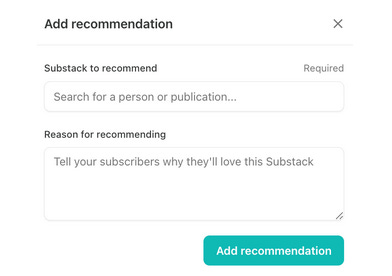
The Value-First Outreach Framework
When you’re ready to reach out, your pitch must focus entirely on what the other writer stands to gain, not what you want to gain. This requires moving away from automation and leaning heavily into personalization.
An effective, non-spammy pitch could follow these steps:
1. Establish Real Familiarity
Never let your pitch be the first time a writer sees your name. Spend two to three weeks interacting genuinely with their work. Leave insightful, value-adding comments on their posts. Share their work within your own Notes feed. Become a recognizable, supportive member of their micro-community.
2. Lead with Genuine Appreciation
When you send your direct message or email, begin by mentioning a specific piece of their writing that genuinely impacted you. Avoid vague praise like “Love your newsletter.” Name the specific article, reference a core argument they made, and explain how it changed your perspective or workflow. This proves you’re an actual reader.
3. Propose the Mutual Benefit
Frame the recommendation as a win-win for the reader. Explain the natural bridge between your publication and theirs. You might point out that your latest deep-dive seamlessly expands upon a point they raised the previous week.
4. Give First
The absolute best way to get a recommendation is to give one first without asking. Put their newsletter on your recommendation list for a few weeks. Let the data do the talking. When you finally reach out, you can casually mention that you have already driven dozens of new sign-ups to their publication because your readers adore their insights. Reciprocity is a powerful human motivator.
5. Provide an Easy Out
High-value people hate feeling trapped or guilted. Always conclude your pitch by giving the recipient a polite exit strategy. Let them know that if their recommendation slot is currently full or if they prefer to keep their list hyper-focused, you completely understand and remain a fan of their work regardless. This lack of pressure usually makes them far more comfortable saying yes.
What to Avoid At All Costs
To protect your reputation on the platform, avoid these common pitfalls:
The Blind Swap: Avoid joining automated engagement Notes or forums where writers swap recommendations regardless of quality. Google and readers alike smell low-quality curation instantly.
The Fast Unfollow: If a writer politely declines your request, don’t stop interacting with their work if you actually like it. If you disappear the moment you get a “no,” you prove that your initial friendliness was entirely surface level.
Overloading Your List: Do not recommend fifty different publications hoping they will all return the favor. Keep your own recommendations curated to under five truly spectacular newsletters. When your list is exclusive, your endorsement carries weight, and other writers will notice the quality of traffic you send them.
Building a sustainable publication takes time, and Substack’s ecosystem rewards genuine human connection. By treating other creators as peers rather than distribution channels, you’ll build a network of organic recommendations that continuously fuels your growth.
If you’d like a Recommendation yourself… we can all connect in the “Comment’s Section” and go from there!
Paul Arino
About: Substack Growth Tips | How To Grow
Master Substack growth with a unique dual-engine strategy. Learn how to combine internal features like Notes and Recommendations with Google SEO and Search Console: Substack Growth SEO Strategy
The Simple Step-by-Step Guide to Connect GOOGLE SEARCH CONSOLE to your Substack Publication so your newsletters will show up on Google Searches: Substack Google Search Console
Learn why chasing followers and likes can ruin your Substack writing. Discover the old-school wisdom of writing for a loyal community of subscribers instead: Substack Writing Tips Subscribers vs Followers
Building a sustainable Substack publication hinges on moving away from transactional "sub-for-sub" tactics and leaning into strategic, relationship-first approaches.
If you want to secure organic Substack recommendations that actually drive high-converting subscriber growth, you have to learn the art of the ask by leading with genuine value, mutual audience alignment, and authentic community engagement.
When you prioritize network-building over growth-hacking, other writers will naturally cross-promote your publication because it adds value to their own readers - making it the most sustainable, non-spammy way to scale your newsletter organically.