
A Detailed Explanation Of What Happens After You Post Your Substack Notes
What actually happens after you post on Substack Notes!

The moment you hit “Post” on Substack Notes, you aren’t just sending text into space. You’re triggering a distinct algorithmic and social distribution sequence. Substack’s ecosystem operates differently from traditional social media networks like X (Twitter) or LinkedIn because its ultimate goal isn’t just ad impressions - it is email subscription conversion.
Here is exactly what happens behind the scenes the second your Note goes live.
Phase 1: The Immediate Distribution Ring (Minutes 1–5)
Substack doesn’t hide your content behind an immediate algorithmic penalty test. It instantly maps your Note to three distinct endpoints based on explicit user relationships.
The Subsriber Feed Push: Your Note is injected chronologically into the “Home” feed of anyone who subscribes to your publication. If they have the Substack mobile app installed and active notifications, a subset of highly engaged subscribers will receive a push notification.
The Profile Ledger: The Note is permanently indexed on your substack.com/profile page under the “Notes” tab. This acts as your public micro-blogging portfolio.
Network Graph Mapping: Substack’s backend identifies your connection to other writers. If you have “Recommended” other publications, or if other writers recommend you, the system prepares to surface your activity to their extended networks based on subsequent engagement.
Phase 2: The Engagement Triggers (Minutes 5–60)
Unlike platforms that rely heavily on complex AI interest graphs from day one, Substack relies on network density. The velocity of early interactions dictates how far your Note travels outside your current subscriber base.
![[Your Note Is Published] [Subscribers Engage: Like, Reply, Restack] [The Substack Graph Triggers Network Effects]](https://substackcdn.com/image/fetch/$s_!9tt-!,f_auto,q_auto:good,fl_progressive:steep/https%3A%2F%2Fsubstack-post-media.s3.amazonaws.com%2Fpublic%2Fimages%2F94eed95b-8785-4266-a5e7-cac4f77eabcb_1024x559.png "[Your Note Is Published] [Subscribers Engage: Like, Reply, Restack] [The Substack Graph Triggers Network Effects]")
The Hierarchy of Value
The algorithm weights user actions strictly by their potential to cause a chain reaction:
Restack with Quote (Highest Weight): This creates a brand-new node in the network graph. It clones your Note and places it directly in front of the restacker’s entire audience, paired with their endorsement.
Simple Restack: Broadcasts your raw Note to the restacker’s followers. It signals high topical relevance.
Replies: Drives deep engagement. Substack threads these replies, meaning a vibrant debate under your Note repeatedly pulls the Note back to the top of the “Active” feed for anyone participating in the thread.
Likes (Lowest Weight): Primarily acts as a social proof signal for casual scannability, though it mildly boosts visibility in the “Discover” tab.
Phase 3: The Algorithm Discovery Filter (Hours 2–24)
Once the initial chronological push fades, your Note enters Substack’s secondary layer: The Discover Tab. This is where true algorithmic curation happens.
Substack evaluates your Note’s performance against two primary metrics during this window:
1. Subscription Velocity
The system measures how many people click your profile directly from that specific Note and subsequently hit the “Subscribe” button. A Note that generates 5 new subscribers from 100 views is prioritized over a Note that gets 100 likes but 0 subscribers. The platform rewards revenue-generating potential.
2. Network Proximity (The “Whom to Show” Engine)
Substack looks at mutual connections. If Writer A (who has 10,000 subscribers) likes your Note, the algorithm does not just show it to Writer A’s subscribers. It selectively tests your Note on the feeds of users who read similar topics to Writer A’s publication, even if they don’t follow Writer A or you yet.
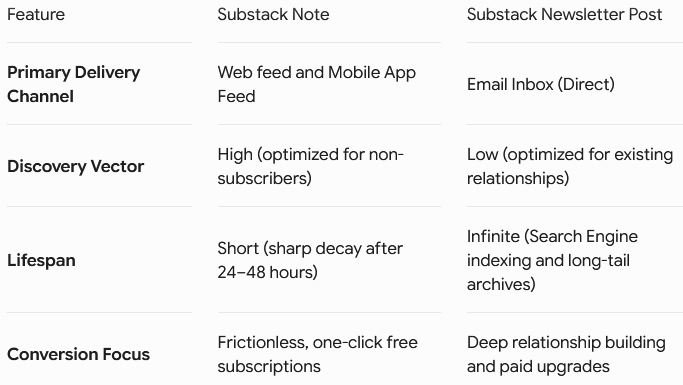
Why Note Distribution Differs From Standard Newsletters
It’s crucial to realize that a Note is structurally distinct from a Substack Newsletter. They serve opposite ends of your growth funnel.
How To Maximize the Post-Publish Window
Because the first 60 minutes heavily dictate whether a Note is pushed to the Discover tab, how you construct it matters.
Lead with an Edge: Treat the first 80 characters like a headline. Feeds truncate long notes; users must be compelled to click “More.”
Tag Strategically, Not Spammy: Tagging another writer embeds your Note into their dashboard notifications. Only do this if you are actively building on their ideas, or it will be flagged as engagement farming, suppressing your graph health.
Engage with Early Responders: Reply to every comment within the first hour. This signals to the platform that the thread is a high-activity zone, extending its chronological shelf-life in subscriber feeds.
Now that you know exactly how Substack Notes work - go use them to help you grow!
I hope you found this as useful as I did?
Paul Arino
Substack Growth Tips | How To Grow
In my previous article, I teach you how to use Substack Notes Scheduling as a Growth Strategy
Thank you for clarifying what was rather foggy before. This gives the secret sauce happening behind the "Substack" curtain and shows which levers to use in spreading "your message."