
How To Write The Perfect Substack Article To Be Featured In AI Search Answers
The Secret to Making Your Substack Articles Visible to AI Search Answers (And Why Most Newsletters Fail)


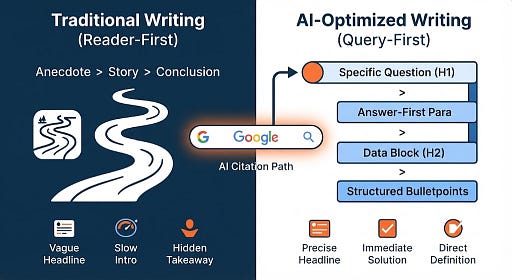
Most writers think the goal of a Substack post is to keep a subscriber glued to the page until the very last sentence. That’s great for retention, but it’s terrible for discoverability.
If you want your writing to appear in Google’s AI Overviews - those bold, summarized boxes that pop up before the actual search results, you have to stop writing for people and start writing for queries.
AI models are not searching for your “thought leadership” or your “writer voice.” They are looking for definitive, structured, and factual answers to specific questions.
If you want to land in the snippet, here is the blueprint.
Structure Your Headlines as Questions
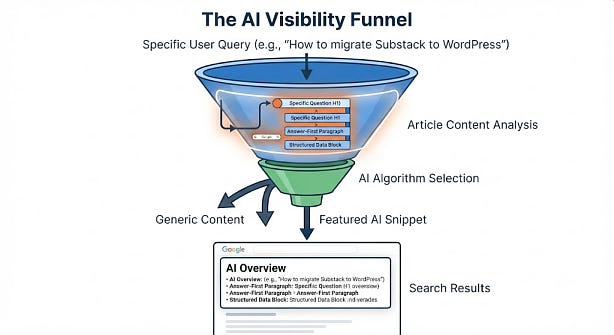
AI systems act as librarians. When a user asks, “How do I grow a newsletter without social media?”, AI scans the web for a page that directly addresses that question.
If your article title is “My Thoughts on Growth,” you will never be found. If your title is “How to grow a Substack newsletter without using social media,” you’ve just handed AI the key.
Use your headers (H2 and H3 tags) to pose sub-questions that a real human would type into a search bar.
The Answer-First Paragraph
AI loves the use of few words to express a point. It wants the answer to be contained in a single punchy paragraph, ideally within the first 100 words of your post.
Don’t start with a three-paragraph personal realization about how you felt while drinking coffee this morning. Start with the solution.
The formula: [The Problem] is best solved by [The Solution] because [Reason]. To do this, you need to [Step 1], [Step 2], and [Step 3].
By front-loading the answer, you make it easy for AI to scrape your content as a complete summary.
Use Definition Blocks
AI models love clear concise definitions. If you’re writing about a specialized topic, create a block of text that defines a key term or process.
Example: “A Substack Recommendation Loop is a growth strategy where writers cross-promote other newsletters to share subscriber bases. It’s effective because it relies on high-trust referrals rather than cold traffic.”
When you isolate a definition like this, you make it incredibly easy for Google to pluck that snippet and put it into an AI answer.
Provide Data or The Friction
AI is great at synthesis but bad at experience. It can’t tell you how a software package feels to use or what happened when you tried a strategy and failed.
To win, include primary data. Don’t just say “cross-posting helps.” Say, “I tracked 50 posts over six months, and cross-posting resulted in a 14% increase in new subscribers, while social media posts resulted in less than 2%.”
AI models are heavily weighted to favor sources that provide original evidence. If your article contains a unique data point or a specific “I tried this and here is exactly what went wrong” section - you may become the most valuable source on the web for that query.
Kill the Vague Headlines
“You Won’t Believe What I Learned About Substack” is the death of your SEO. It provides zero context for AI.
AI doesn’t know what you learned, and it won’t gamble on your link to find out.
Be boringly specific.
Bad: The Truth About Substack.
Good: A step-by-step guide to migrating a WordPress blog to Substack.
The Litmus Test
Before you hit publish, ask yourself… If AI had to explain this topic to a user in three sentences, could it pull the answer directly from my headers and first paragraph?
If the answer is yes, you started writing a map for AI to find you. You aren’t just writing a post - you’re building a resource that the internet’s most powerful tools need to cite to stay relevant.
3 Reasons WHY You Want To Be Featured On AI Overviews
Enhanced Brand Authority and Trust: Being cited as a source in AI Overview signals to both Google’s systems and your readers that your content is trustworthy, authoritative, and expert-level. This halo effect can strengthen your reputation even among users who do not click through to your site, as it associates your brand with credible information.
Prime Visibility and "Top-of-Funnel" Exposure: AI Overviews occupy the most prominent space at the top of search results - often appearing before traditional organic links. This placement guarantees high brand recognition and puts you in front of users early in their research process, creating a foundation for discovery even in a search environment where some queries become zero-clicks.
Access to Qualified, High-Intent Traffic: While AI features may reduce the total volume of casual clicks, the traffic you do receive is often higher quality. Users who click through from an AI summary are typically more educated on the topic and have a genuine high-intent interest in reading the in-depth context or unique insights that only your full article can provide.
Have you tried optimizing your Substack articles for AI search yet?
Paul Arino
Substack SEO Growth Strategies
Basically, this article explains that in order to land your Substack content in Google’s AI Overviews, you must shift your writing strategy from narrative-driven storytelling to query-focused structural design.
By framing your article headlines as direct answers to specific user questions, front-loading the solution in your first 100 words, and incorporating definition blocks for key concepts, you provide AI models with the clean, factual architecture they need to scrape and cite your work.
Also, by replacing vague titles with specific search terms, and then backing your claims with primary original data - increases your content from mere commentary, to an authoritative resource, granting you prime visibility at the top of search results and attracting a higher caliber of intent-driven traffic to your Substack publication!
Here's a few more of my Substack SEO Growth Strategies: https://howtotipstricks.substack.com/t/substack-seo
- Paul Arino