
An Effective Online Marketing Strategy using Substack: "Read what I know" "Solve what I can't"
This is a Substack online marketing strategy stripped of the noise. Give them your mind, then sell them your hands.

The internet is drowning in content. Most of it is garbage. Every day, thousands of brand-new business owners buy a domain, open a laptop, and dump generic, AI-generated filler onto the web. They think they are marketing. They are actually just spinning their wheels.
If you’ve never sold a thing online before, the sheer volume of advice is terrifying. You’re told to write blogs, optimize for keywords, and post three times a day.
None of that matters if your content doesn’t answer two foundational human impulses: “Read what I know” and “Solve what I can’t.”
These two phrases are the twin pillars of internet marketing. Master them, and you control attention. Ignore them, and you stay invisible.
Why Google Doesn’t Care About Your Expertise
Let’s kill a myth right now. No one really cares about your brand story (unless it’s built on that story itself).
When people open a browser, they’re looking for one of two things - a specific piece of information they lack, or an immediate solution to a painful problem. They don’t want a “holistic journey.” They want answers.
Traditional marketing tells you to build a website that talks all about you - your mission, your values, your history. That is a trap. Effective online marketing flips the lens. It focuses entirely on the person sitting on the other side of the screen.
Phase 1: “Read What I Know” (Capturing Absolute Authority)
This is your leverage point. You possess specific, hard-won knowledge about your industry. The kid fresh out of college running an agency doesn’t have it. The software developer in another country doesn’t have it. You do.
“Read what I know” is the strategy of intellectual dominance. It means putting your unique insights out in the open where they cannot be ignored.
Stop Writing Summaries
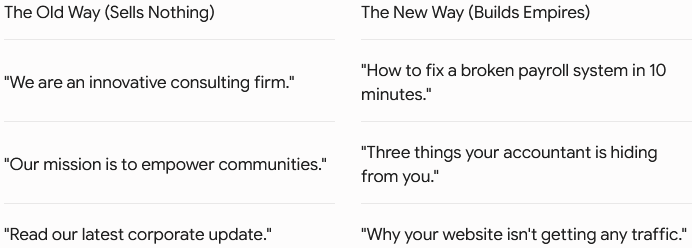
If a reader can find your exact article by reading a Wikipedia page, delete it. Your content needs to offer a distinct point of view. If you run a plumbing business, don’t write “How a Pipe Works.” Write “The Three Costly Mistakes Local Plumbers Make When Fixing a Main Line.”
Drop the Corporate Mask
Speak like a human. The internet rewards authenticity because it is incredibly rare. Use the exact language your customers use when they are frustrated.
Share the Secret Sauce
Many beginners fear that if they give away their knowledge for free, no one will hire them. The opposite is true. When you show people exactly how the clock is made, they don’t buy the tools to build their own - they hire you to build it because they realize how hard it is.
Phase 2: “Solve What I Can’t” (The Conversion Engine)
Authority is useless if it doesn’t make money. Once a reader acknowledges that you know your stuff, they immediately look for the exit unless you offer to solve their problems.
This is where “Solve what I can’t” comes in. This is your product, your service, your offer.
![[Deep, Specific Knowledge] ---> [Builds Trust] ---> [Relieves Immediate Pain] ("Read what I know") ("Solve what I can't")](https://substackcdn.com/image/fetch/$s_!gHS2!,f_auto,q_auto:good,fl_progressive:steep/https%3A%2F%2Fsubstack-post-media.s3.amazonaws.com%2Fpublic%2Fimages%2F7c825c2e-6905-44d6-b4f6-19346c64339c_474x213.png "[Deep, Specific Knowledge] ---> [Builds Trust] ---> [Relieves Immediate Pain] (\"Read what I know\") (\"Solve what I can't\")")
The transition from information to sales must be clean. You do not trick people into buying. You position your offer as the natural next step for someone who wants to save time, money, or sanity.
Find the Bleeding Spot
People buy things to move away from pain, not to move toward pleasure. What keeps your ideal customer awake at 2:00 AM? If you sell software, it’s not “inefficient workflows” - it’s the fact that they might miss payroll this month. Address the real pain.
Make the Outcome Obvious
Do not sell features. Sell outcomes. A customer doesn’t buy an eight-week fitness program because they love sweating - they buy it because they want to look in the mirror and feel confident again.
Eliminate the Friction
If a customer has to click four links, fill out a twelve-field form, and wait for a callback just to give you money, they will quit. Make the buying process dead simple. One button. One clear price. One obvious result.
How to Build the System in 48 Hours
You don’t need an agency to start doing this today. You don’t need a five-figure budget. You need a keyboard and an internet connection.
Audit your brain: Write down the top five questions customers ask you when they’re angry or confused. Those are your first five articles. (This is your Read what I know phase).
Define the transformation: Write down exactly what happens to a person’s life after they buy your product or service. If you can’t describe the change in one sentence, your offer is too complicated. (This is your Solve what I can’t phase).
Connect the dots: At the bottom of every piece of knowledge you share, place a direct call to action.
“Now you know how this works. If you want us to handle the heavy lifting so you don’t ruin your weekend, click here.”
That is how to use Substack to sell your product or service. That is online marketing stripped of the noise. Give them your mind, then sell them your hands.
Paul Arino
Substack Growth Tips | How To Grow